
How much do you know about the continent of Africa? Do you think of it as a land filled with primitive peoples living in thatch and mud huts? Well, think again! We have collected some really great information about Africa that will blow your mind.
To begin with, Africa is the second largest continent in the world after Asia. The African continent covers about 30,065,000 square kilometers (about 11,608,161 square miles) of dry land. The Tropic of Cancer, the Equator, and the Tropic of Capricorn all pass through Africa. No other continent is crossed by all three parallels (latitudes). Despite being the second largest continent in the world, Africa has the shortest coastline because it has the fewest bays and jagged edges.
There are more than 800 ethnic groups of people living in Africa today, and they speak more than 1,000 languages. The most widely spoken language in Africa today is Arabic with about 170 million speakers. English is the second most widely used language with about 130 million speakers. Swahili and French are the only other languages with more than 100 million speakers in Africa. About twice as many Africans (20 million) speak Portuguese as speak Spanish (10 million).
One of the most famous landmarks in Africa is the Sahara desert. When you see the desert in movies and television shows you easily get the impression that the desert is like a vast sea of sand dunes stretching for thousands of miles. In reality, the vast majority of the Sahara’s landscape is comprised of rocky hills and plains. Yes, there is sand there but relatively few dunes. You may also be surprised to know that the Sahara also contains a lot of water. The region is a desert because it experiences relatively little rainfall.
Despite the fact that most of their land is located in the Sahara desert, both Morocco and Algeria each have more arable (farmable) land than Italy. Tunisia and Libya both have more arable land than Hungary. The arable lands of north Africa are located in the Atlas Mountains, which are famous throughout western history and mythology.
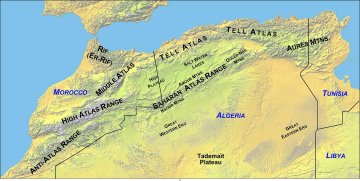
The Atlas Mountains create a large rain shadow in northern Africa.
One of the most important reasons why the Sahara is a desert today is that the Atlas Mountains, which extend from Morocco to northern Algeria, create a vast rain shadow. Storms that sweep in over the western coast of Africa from the Atlantic ocean are blocked by the mountains, which extend for many miles inland. Conversely, climatologists have learned that dust from the Sahara often drifts into the skies above the Atlantic ocean, seeding clouds that become powerful storm systems.
The Atlas Mountains are named for a Titan from Greek mythology. Ancient Greek culture was once so dominant throughout the Mediterranean Sea and adjoining lands that many landmarks still bear names bestowed upon them by the Greeks who first explored and colonized many of the Mediterranean lands. The Arabic and Berber names for the mountains also contain the name of Atlas.
There are more cell phone users (subscribers) who live in Africa than there are in North America. In fact, throughout the 1990s and early 2000s most people in Africa had Internet access only through their cell phones. More than 1 billion people live in Africa and 7 of the world’s fastest growing economies are found in Africa.
There are more than 200 pyramids in Sudan, more than twice as many pyramids as are known to exist in Egypt. However, scientists believe there may still be undiscovered pyramids buried beneath the sands of Africa in both Egypt and Sudan.

A Cycad tree, the last of its kind. These 200 million year old trees have two sexes but only a male line survives.
Africa is home to the last known wild growing Cycad tree. This tree was discovered in 1895 in the Ngoya Forest in Zululand (a kingdom located in South Africa) by British botanist John Medley Wood. The Cycad was the only one of its kind left in the world. Cuttings have been used by botanists to clone the tree but it is of a species that requires both male and female trees. The South African Cycad and its clones are all male. These trees were once the dominant tree species on Earth and they co-existed with dinosaurs. Cycads can be cross-bred with similar, related species and the hybrids are often sold in stores. Unfortunately, scientists may never find a mate for the lonely Cycad, although they may one day stumble across some well-preserved seeds. Cycads have lived on the Earth for 200 million years and were once found in Antarctica and every other continent.
Of the six floral kingdoms that encompass the globe, one is wholly contained in South Africa. The South African floral kingdom contains almost 10,000 plant species, of which about 70% are found nowhere else in the world. Table Mountain, located in Cape Town, South Africa, is believed to be one of the oldest mountains in the world. Table Mountain is also home to more than 1500 species of plants, more than are found in Great Britain.
Lagos, Nigeria and Cairo, Egypt both have more than 20 million people. More than a dozen other cities in Africa have nearly 3 million or more people each.