
The works of William Phelps Eno, John Harrison, Étienne Lenoir, Levi Strauss, and Cai Lun are of profound significance in various domains. William Phelps Eno, known as the “Father of Traffic Safety,” introduced traffic management innovations that continue to enhance road safety globally. John Harrison’s marine chronometer revolutionized navigation by enabling precise determination of longitude at sea.
Étienne Lenoir’s early internal combustion engine laid the foundation for modern automobile engines, reshaping transportation and industry. Levi Strauss’s invention of blue jeans, initially for miners, became an enduring symbol of American culture and fashion. Lastly, Cai Lun’s invention of paper around 105 CE revolutionized communication and knowledge dissemination.
These inventors’ contributions span traffic safety, navigation, transportation, fashion, and written communication, collectively shaping human civilization and improving the quality of life for generations. Their enduring impact underscores their significance in the history of innovation.
1 – William Phelps Eno
William Phelps Eno (1858-1945) was an American inventor and traffic consultant who is often referred to as the “Father of Traffic Regulation.” He was born in New York City and became a prominent figure in the field of urban transportation and traffic management during the late 19th and early 20th centuries.
Eno is best known for his pioneering work in developing traffic control systems and road signage. In 1903, he published a book titled “Street Traffic Regulation,” which laid out many of his ideas and recommendations for improving the flow of traffic in urban areas. Eno’s book proposed the use of standardized road signs, one-way streets, and various traffic rules that would later become the basis for modern traffic management.
Some of Eno’s other contributions to traffic safety and regulation include the concept of using white lines to separate lanes of traffic, the use of traffic islands and pedestrian crosswalks, and the idea of traffic circles or roundabouts. His work and ideas significantly influenced the development of traffic engineering and road safety practices in the United States and around the world.
Eno’s legacy lives on in the form of safer and more organized urban traffic systems, which continue to benefit cities and their residents to this day.
2 – John Harrison
 John Harrison (1693-1776) was an English clockmaker and inventor known for his pioneering work in the field of marine navigation. Born in Foulby, West Yorkshire, England, Harrison came from a humble background with limited formal education but showed an early interest in horology.
His most significant achievement was the invention of the marine chronometer, a highly precise timekeeping device designed specifically for use at sea. Before the advent of the chronometer, sailors struggled to determine their longitude accurately, leading to hazardous navigation errors.
Harrison’s chronometer development spanned several decades and included notable models like H1, H2, H3, and H4. H4, in particular, marked a breakthrough and is often regarded as the first practical marine chronometer. It was a compact and reliable timepiece that could accurately maintain time at sea.
His work addressed the longstanding “longitude problem,” for which the British government had offered the Longitude Prize, a substantial reward for a reliable method to calculate longitude at sea. Harrison’s chronometers provided a solution by allowing sailors to compare local time (measured by the chronometer) with the time at a known reference point, such as Greenwich, England.
John Harrison faced considerable controversy and disputes with the Board of Longitude, which administered the Longitude Prize, before eventually receiving recognition and financial rewards for his groundbreaking work. Despite the challenges, his chronometers revolutionized marine navigation, greatly enhancing the safety and reliability of long-distance sea travel.
Harrison’s legacy endures in the fields of science and technology. His contributions to horology and navigation laid the foundation for accurate navigation at sea and played a crucial role in the exploration and expansion of the British Empire during the Age of Exploration and beyond. Today, his chronometers are esteemed historical artifacts displayed in museums worldwide. John Harrison passed away on March 24, 1776, in London, England.
3 – Étienne Lenoir
Étienne Lenoir (1822-1900) was a Belgian engineer and inventor best known for his pioneering work in the development of the internal combustion engine. He was born in Mussy-la-Ville, Belgium, and later became a naturalized French citizen. Lenoir had a diverse range of interests and inventions throughout his career, but his most significant contribution was the creation of one of the first practical internal combustion engines.
In 1860, Lenoir patented his internal combustion engine, which was notable for its use of coal gas as a fuel source and an electric spark ignition system. This engine marked an important milestone in the history of automotive and engine technology, as it demonstrated the feasibility of using an internal combustion process to produce mechanical work.
Lenoir’s engine, while groundbreaking, was not highly efficient and was mainly used for stationary applications, such as powering industrial machines and generating electricity. Despite its limitations, Lenoir’s work laid the foundation for subsequent advancements in internal combustion engine design, which ultimately led to the development of the more efficient and practical engines that powered automobiles and other machines in the 20th century.
4 – Levi Strauss
Levi Strauss (1829-1902), originally named Loeb Strauss, was a notable American businessman renowned for founding Levi Strauss & Co., a company credited with popularizing denim jeans. Born on February 26, 1829, in Buttenheim, Bavaria, Germany, he embarked on a journey to the United States in 1847 to join his older siblings, who were already engaged in a dry goods business in New York City. It was at this point that he adopted the name Levi Strauss.
Upon his arrival in the United States, Levi Strauss worked at his family’s store in New York City before eventually relocating to San Francisco, California, in 1853. In the midst of the California Gold Rush, he established his own dry goods business, catering to the needs of gold miners by selling clothing, fabrics, and various supplies.
Levi Strauss’s most enduring contribution to fashion history was his role in popularizing blue jeans. In collaboration with Jacob Davis, a skilled tailor, Strauss secured a patent in 1873 for using rivets to reinforce key stress points in denim pants. This innovation led to the creation of the world’s first true blue jeans, designed for durability and favored by laborers and miners.
In 1873, the official establishment of Levi Strauss & Co. took place, and the company introduced the iconic “501” jeans, featuring a button fly. These jeans gained immense popularity and have continued to be a fashion staple.
Aside from his business endeavors, Levi Strauss was known for his philanthropic activities in San Francisco, where he supported various charitable causes and community organizations.
Levi Strauss passed away on September 26, 1902, in San Francisco, but his legacy endures. Levi Strauss & Co. remains a major player in the fashion industry, known for its denim products. Levi’s jeans have transcended their origins as workwear to become a global fashion icon, symbolizing American style and cultural significance.
5 – Cai Lun
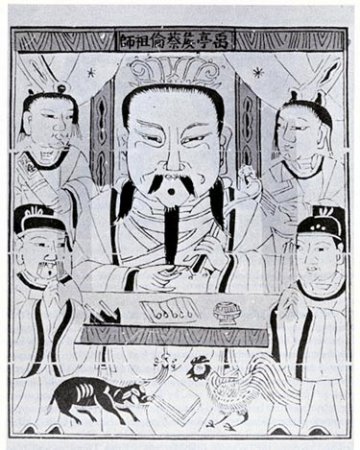 Cai Lun was a Chinese inventor and eunuch of the Han dynasty, known for his crucial role in the development of paper. Born around 50 CE in Guiyang (modern-day Leiyang, Hunan province, China), Cai Lun lived during the Eastern Han dynasty.
His most significant contribution was the invention of paper, which revolutionized the way information was recorded and shared. Before his time, various materials such as bamboo strips, wooden tablets, and silk were used for writing and record-keeping. Cai Lun’s papermaking process, introduced around 105 CE, involved a mixture of mulberry bark, hemp, old fishing nets, and other plant fibers. This innovation led to the creation of a more affordable, versatile, and accessible writing material compared to previous alternatives.
Cai Lun’s papermaking process included steps such as pulping the fibers, forming a sheet of paper on a screen, and then drying the sheet. He also introduced techniques to improve paper quality and consistency.
The invention of paper had a profound impact on Chinese society and culture, making writing and communication more accessible to a broader range of people. It was cheaper and more readily available than alternative writing materials. Over time, knowledge of papermaking spread along trade routes to other parts of Asia, the Middle East, and eventually to Europe. This dissemination of paper technology played a crucial role in the spread of knowledge, education, and literature.
Cai Lun was recognized and honored by later Chinese dynasties for his invention. His contribution to papermaking is considered one of the Four Great Inventions of ancient China, alongside printing, gunpowder, and the compass. These inventions played a significant role in advancing civilization and technology globally. Cai Lun’s legacy continues to be celebrated in China and worldwide.
Conclusion
These five inventors have left an indelible mark on society through their diverse range of innovations. From enhancing traffic safety to facilitating precise navigation, from revolutionizing clothing to transforming the methods of recording and sharing information, their groundbreaking contributions have shaped our world in profound ways. Even today, the ripple effects of their inventions continue to permeate our lives, leaving an enduring legacy.
The inventors’ remarkable achievements have transcended their respective fields, leaving a lasting impact on countless aspects of modern life. Their work in traffic safety has saved countless lives, making our roads safer for all. The advent of precise navigation has not only simplified our daily commutes but has also enabled the exploration of uncharted territories. In the realm of fashion, their innovations have not only elevated our sense of style but have also had far-reaching implications for the textile industry. Moreover, their role in transforming information recording and sharing has brought about an information age that has redefined how we learn, communicate, and access knowledge.
In a rapidly evolving world, these inventors serve as a testament to the power of human ingenuity and its capacity to shape the course of history. Their contributions remind us that innovation knows no bounds and that the legacy of their inventions continues to shape the world we live in today, leaving an indelible mark on society for generations to come.